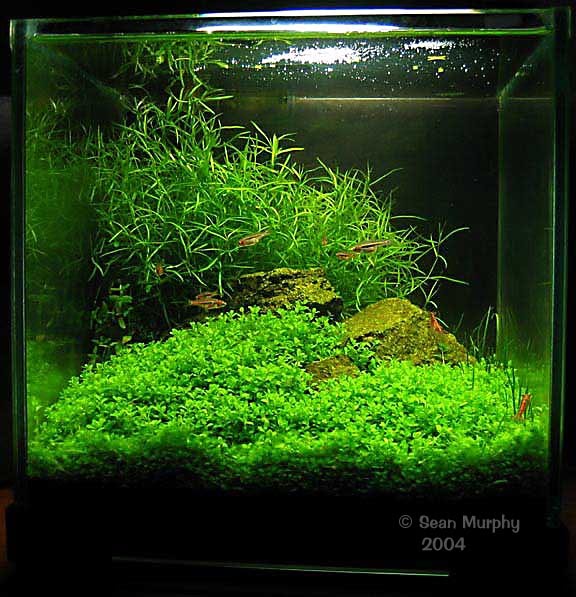
Image result for nano aquascape Aquarium Pinterest Aquariums, Fish
tanks and Fish aquariums
Aquascaping is the craft of arranging aquatic plants, as well as rocks, stones, cavework, or driftwood, in an aesthetically pleasing manner within an aquarium—in effect, growing plants under water. Aquascape designs include a number of unique styles, including the garden-like Dutch style and the Japanese-inspired nature style. Usually, an aquascape houses seafood as well as plants, although it is possible to create an aquascape with plants only, or with rockwork or other hardscape and no vegetation.Although the primary aim of aquascaping is to create an artful underwater landscape, the technical aspects of tank maintenance and the growth requirements of aquatic plants are also taken into consideration. Several factors must be well balanced in the closed system of an aquarium container to ensure the success of the aquascape. These factors include filtration, maintaining co2 dioxide at levels sufficient to support photosynthesis marine, substrate and fertilization, illumination, and algae controlNederlander style aquascapeThe Nederlander aquarium employs a lush arrangement in which multiple types of plants having diverse leaf colors, dimensions, and textures are shown much as terrestrial plant life are shown in a flower garden. This style was developed in the Netherlands starting in the 1930s, as freshwater aquarium equipment became commercially available. It emphasizes plants located on terraces of different heights, and frequently omits rocks and driftwood. Linear series of plants running left-to-right are referred to as "Dutch streets". Although many plant types are utilized, one typically sees neatly trimmed groupings of plants with fine, feathery foliage, such as Limnophila aquatica and various types of Hygrophila, along with the use of red-leaved Alternanthera reineckii, Ammania gracilis, and assorted Rotala for color highlights. More than 80% of the aquarium floor is covered with plants, and little or no substrate is left visible. Tall growing plant life that cover the back again glass actually served the purpose of hiding heavy equipment behind the tank.
Annika Reinke and Aquascaping Aqua Rebell
Iwagumi styleAquarium with gray stones arranged to form a tall directed structure at the right, and a similar but smaller structure at the left. The stone highs and the foreground are largely but not totally protected by a short level of fine textured eco-friendly plants.Iwagumi style aquascape, with the Oyaishi stone at the rightThe Iwagumi style is a certain subtype of the nature style. The Iwagumi expression itself comes from the Japanese "rock formation" and refers to a layout where stones play a leading role. In the Iwagumi style, each stone has a name and a specific role. Rocks provide the bony structure of the aquascape and the typical geometry employs a design with three main stones, with one larger stone and two other smaller stones, although additional rocks may also be used. The particular Oyaishi, or main stone, is put slightly off-center in the tank, and Soeishi, or accompanying gemstones, are grouped near it, while Fukuseki or supplementary stones, are arranged in subordinate positions. The location of the focal point of the display, determined largely by the asymmetric placement of the Oyaishi, is considered important, and follows ratios that reveal Pythagorean tuning.
u2018Zigzag gorgeu2019 by Louis Nincsics HAC 2014 entry Very beautiful nano scape! Nice touch
Large general public aquariums sometimes use aquascaping as part of their displays. As early as the 1920s, the New York Aquarium included a moray eel display tank which was embellished with calcareous tufa rock, arranged to resemble a coral reef, and helping some stony corals and sea fans.[45] Because they typically present wildlife from a particular habitat, modern day displays are often created to be biologically accurate biotopes
Basic Aquascaping Principles and Technique Aquascape Aquarium Freshwater Aquarium Plants for
Nano Aquascapes Aquascaping Aquarium
Related Images with Image result for nano aquascape Aquarium Pinterest Aquariums, Fish tanks and Fish aquariums
source image Nano Aquascape from www.pinterest.com
 Aquascaping is the craft of arranging aquatic plants, as well as rocks, stones, cavework, or driftwood, in an aesthetically pleasing manner within an aquarium—in effect, growing plants under water. Aquascape designs include a number of unique styles, including the garden-like Dutch style and the Japanese-inspired nature style. Usually, an aquascape houses seafood as well as plants, although it is possible to create an aquascape with plants only, or with rockwork or other hardscape and no vegetation.Although the primary aim of aquascaping is to create an artful underwater landscape, the technical aspects of tank maintenance and the growth requirements of aquatic plants are also taken into consideration. Several factors must be well balanced in the closed system of an aquarium container to ensure the success of the aquascape. These factors include filtration, maintaining co2 dioxide at levels sufficient to support photosynthesis marine, substrate and fertilization, illumination, and algae controlNederlander style aquascapeThe Nederlander aquarium employs a lush arrangement in which multiple types of plants having diverse leaf colors, dimensions, and textures are shown much as terrestrial plant life are shown in a flower garden. This style was developed in the Netherlands starting in the 1930s, as freshwater aquarium equipment became commercially available. It emphasizes plants located on terraces of different heights, and frequently omits rocks and driftwood. Linear series of plants running left-to-right are referred to as "Dutch streets". Although many plant types are utilized, one typically sees neatly trimmed groupings of plants with fine, feathery foliage, such as Limnophila aquatica and various types of Hygrophila, along with the use of red-leaved Alternanthera reineckii, Ammania gracilis, and assorted Rotala for color highlights. More than 80% of the aquarium floor is covered with plants, and little or no substrate is left visible. Tall growing plant life that cover the back again glass actually served the purpose of hiding heavy equipment behind the tank.


Comments
Post a Comment